Business Cycles & Exit
We talk to farmers about the “Toyota windscreen” model: Be clear about your destination, where you wish to get to, the GPS. The rear-view mirror is important as is provides wisdom, experience, knowledge and hopefully lessons learned; but we need to spend nearly all our time looking out the windscreen. Look forward to the future (the windscreen) for possibilities, opportunities, innovation, and business improvement; changing the route, making small adjustments to avoid potholes (“the inches”), focussing on the conditions ahead. Regularly investing time in the planning process, just like exercise, builds the reliance and adaptability muscles, providing increased strength to face future challenges. It can also provide reasoned inspiration and optimism in the future.
The same applies to all businesses, although one difference is the destination. For many farmers it’s the succession plan. For businesses it’s the exit strategy. An exit strategy is not something that is developed and implemented in a matter of months. Or it can be, but will usually result in poorer outcomes. Determining the vision for your exit strategy should start 5 years before the event to maximise the value.
Our view of business cycles, learned in the naughties, is demonstrated in the image below:
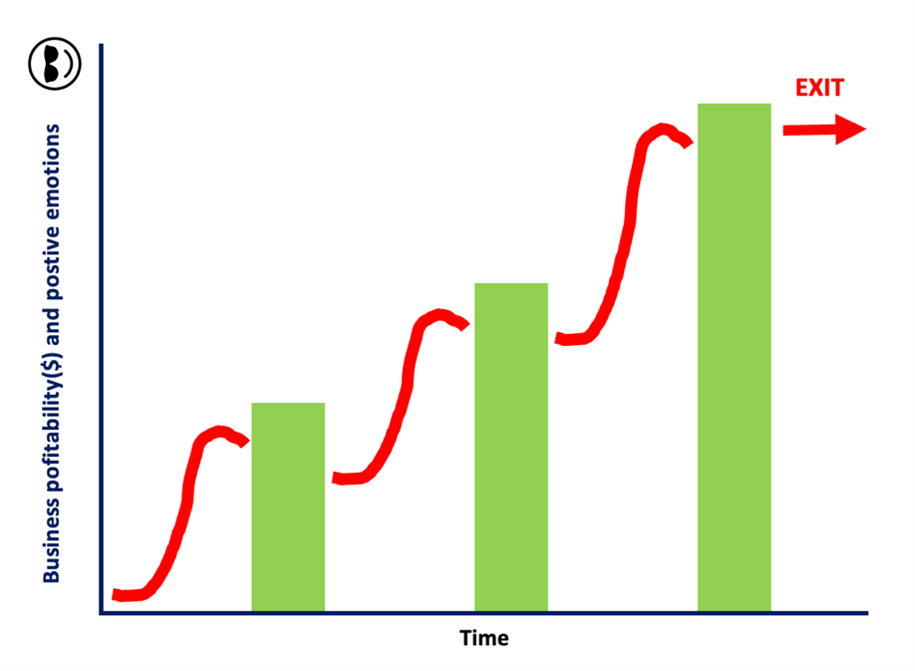
The left-hand side of the chart is the level of profit and happiness of the owners in the business. Initially, its hard work, and then momentum builds and things become easier. Owners are excited and happy as the business grows.
However, most businesses growth cycles reach a point where owners become frustrated, things are not working as they should be, stress levels rise and the business hits a blockage or brick wall. To overcome or “break through” that wall, requires an investment. That investment might be a piece of equipment, a new employee, new skills or a change in mindset, roles etc.
Once the investment is made, it again takes effort and hard work to begin the cycle of profit growth generating joy and exuberance………before again a blockage or next wall is met.
The cycles continue until an exit eventuates, planned or otherwise.
For many clients, the most significant asset they own is their business. Why not do everything possible to maximise the value of that asset, to consider the many options to exit the business, to prepare the business for sale. Importantly, approaching your business adviser or accountant when you wish to sell the business is too late.
Just like succession planning for farmers, start early, identify the time you wish to exit and put the planning and preparation for sale process in place. For many of us, building a business is a lifelong endeavour. Why give away all that effort, all that value?
by Pete Debus