The Family Farm vs Corporate Farming
There is much discussion and comparison between the family farm and farming activities undertaken by corporate farms. “Family farm” and “corporate farm” are often defined as mutually exclusive terms, with the two having different interests, and in the US (less so in Australia) there is increasing level of corporate farming, often accompanied by negative community sentiment.
The family farm business model, where farm assets and farming operations, including management and labour, are usually provided as a whole by the family, has generally served Australian agriculture well. However, there are situations where ‘internal’ contribution of the farm’s assets and operations will not deliver the best outcome for the business or the people involved.
Corporate farming is based on the separation of farm business resources, with a clear delineation of farm asset ownership, business management and reliance on employed labour for farming operations. Within this model, farm assets and operations are commonly separated in the business structure to protect assets from operational risks by breaking down the farm business into distinct business resources.
However, there is a perception that in Australia a new breed of farm is gaining predominance – the “family corporate farm”.
The key attributes of the defined farming structures are suggested below. In preparing this document we have considered many attributes of traditional, family corporate and corporate farm business models. In doing so, we have considered the traditional family farming model across Australia, rather than considering our client base. PrincipleFocus has worked with our client base to educate and implement many attributes that are more prevalent in the family corporate business model. That is, we have been working behind the scenes to migrate our clients to a culture and business management framework of family corporates. However, attributes that many of our client exhibit that keep them in the traditional family farming model are: they want to be; scale; a minimal growth mentality; access to capital; a succession framework (or lack thereof)
Suggested attributes of the differing farming models are:
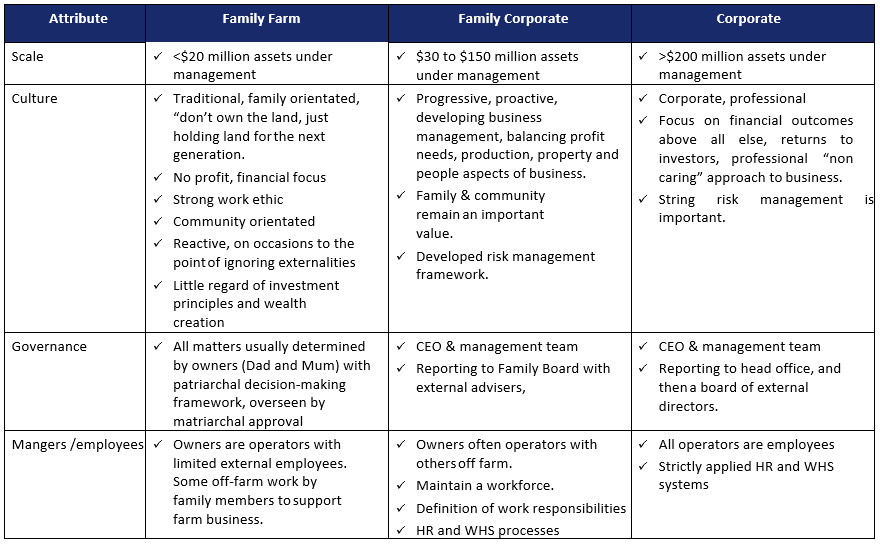
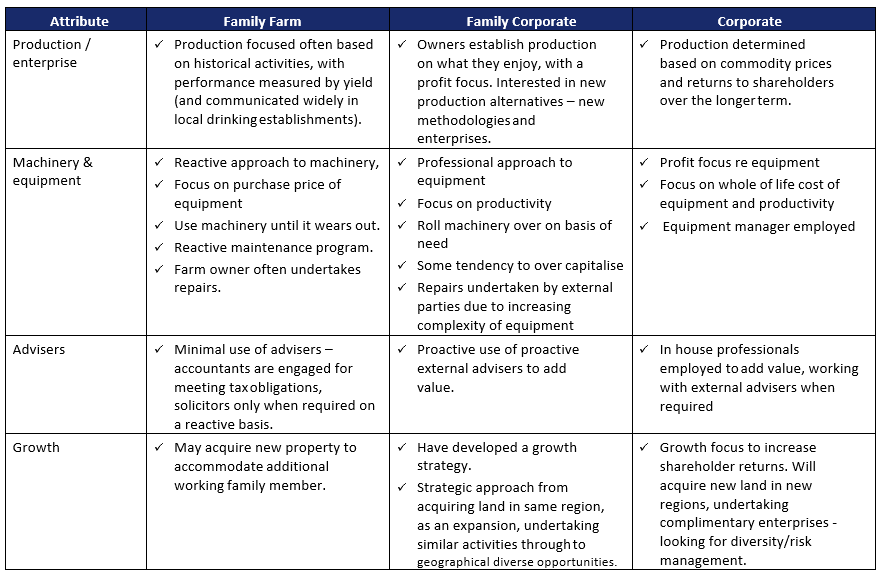
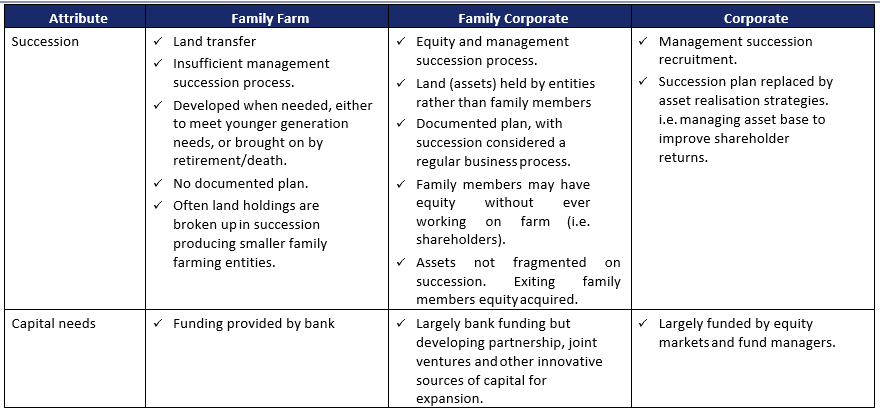
Some additional comments and further readings are identified below or attached from expert reports worth noting include:
Farm ownership
Although broadacre farming in Australia remains largely the province of family-owned and operated businesses, corporate farming is on the rise. Corporate and foreign ownership of Australian farmland attracts much media and political scrutiny. As at 30 June 2017, around 10% of the farmland in most mixed cropping and grazing regions of Australia were corporately-owned and at 30 June 2017, 13.6% (FIRB 2017) of Australian agricultural land was wholly or partly foreign-owned (with around half of the latter in majority Australian ownership). This compared with 5.9% of agricultural land being wholly or partly foreign-owned in 1984. In general, there is little churn in cropping zone farmland ownership (Pritchard et al. 2012) which is typically around 4% per annum, suggesting most farmland is owned and operated over the long term. ABS (2018) indicates the average duration in farming is around 37 years. This longevity of familial ownership of farms gives rise to succession issues in farming being a potentially problematic business and social issue. However, farm families are having fewer children and provide their children with greater levels of education to facilitate some children pursuing careers outside of farming. However, ensuring within and across generational equity remains a general problem in farm succession. When farmland is sold, the purchaser is usually another family farm business in the district or a corporate or family farm operation outside the district. Increasingly, family farms operate as a corporate business. Financial duress imposed by events such as the millennial drought provided investment opportunities for corporates.
Australian agriculture is changing, driven by globalisation, industry deregulation, declining terms of trade, technological innovation, supply chains, consumer preferences and an ageing farm population (Productivity Commission, 2005). To remain competitive, Australian agriculture has continually made productivity improvements within the agri-industrial model, and this standardised approach continues to dominate Australian agriculture. This focus on agri-industrial agriculture is causing a cultural shift towards a larger corporate business model of agricultural production, making many smaller family farm businesses uncompetitive and forcing them to leave the industry. Those family businesses that have remained have had to either develop new income streams and/or increase their scale of production, adopting more business-like approaches and structures. Family members are now often working off–farm, while new income is alternatively sought through diversification, value-adding and niche marketing, or a combination of these strategies in what is described as a rural development model of agricultural contribution.
https://www.producer.com/2019/10/weighing-pros-and-cons-of-single-family-farm-corporation/ KPMG advice re restructuring a Canadian family farm to establish a corporate model